Skip to content
Natural Sciences

Natural Sciences

Experimental research developments

Galaxies Clusters Dynamics and Masses in the 21st Century

Posted on 9th November 20249th November 2024 By Stephen Drury No Comments on Galaxies Clusters Dynamics and Masses in the 21st Century

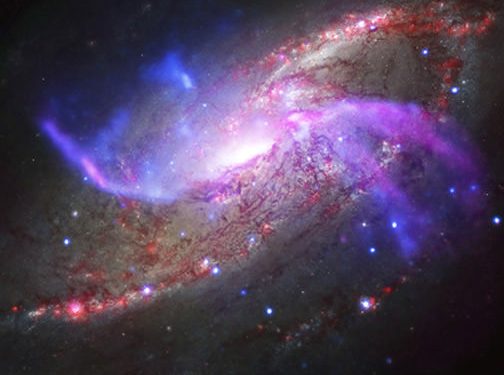
Newton’s Principia in 1687 introduced universal gravitation correlating the dynamics of all masses. In the 19th century it becomes clear that astronomical processes can be investigated by physical experimental methods with William Herschel and Joseph Fraunhofer using prisms to find out about stellar radiation and Friedrich Bessel uses stellar parallax to calculate the distance of 61 Cygni. In 1925 Edwin Hubble confirms that Andromeda is another galaxy like our own and by measuring its distance suggests the scale of the universe. All this combines together in the 21st century with the James Webb telescope observations of galaxies clusters strong gravitational lensing to find dynamical masses that come concentrating from the whole universe.

  • Share on X (Opens in new window) X
  • Share on Facebook (Opens in new window) Facebook

Like this:

Like Loading…
Uncategorized

Post navigation

Previous Post: Aurorae of the Solar System
Next Post: Astronomical Developments to the 20th and 21st Centuries

More Related Articles

Physics in the 21st Century Uncategorized
The experiments of Chien-Shiung Wu Uncategorized
Deep Uncategorized
Energies coming together through Quanta Function as Mass in Dynamics of Galaxies Clusters Uncategorized
Ancient Irish Star Stone Uncategorized
Deep Natural Human Life Developments Uncategorized

Leave a Reply Cancel reply

Copyright © 2026 Natural Sciences.

Powered by PressBook Green WordPress theme

Loading Comments...
%d